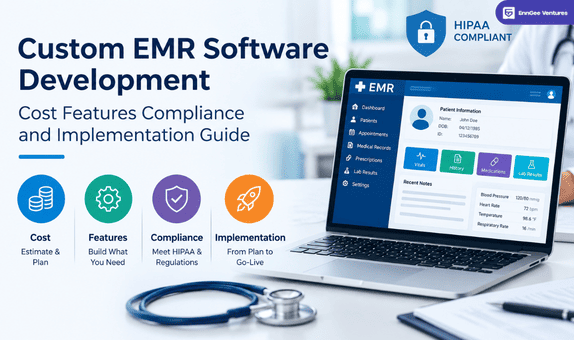
Custom EMR Software Development: Cost, Features, Compliance and Implementation Guide
Marketing Team
October 6, 2026 ∙
25 min read
At Enn Gee Ventures, we develop custom EMR software tailored to the unique needs of healthcare providers, helping streamline clinical workflows, improve patient record management, and support regulatory compliance. This guide covers the cost, essential features, compliance requirements, and implementation process to help you build a secure and efficient EMR solution.
Understanding Custom EMR Software Development
As healthcare organizations continue to embrace digital adoption, Electronic Medical Record (EMR) software has become an essential tool for improving patient care and operational efficiency. While many providers use ready-made EMR platforms, custom EMR software offers greater flexibility by adapting to specific clinical workflows and business requirements. It enables healthcare organizations to manage patient information securely, improve collaboration among medical professionals, and support long-term growth.
Understanding Electronic Medical Record (EMR) Software
Electronic Medical Record (EMR) software is a digital solution that stores and manages patient health information within a healthcare organization. It replaces paper records with electronic documentation, allowing healthcare professionals to access medical histories, prescriptions, diagnoses, and treatment plans more efficiently. By centralizing patient data, EMR systems help improve accuracy, reduce paperwork, and support faster clinical decision-making.
Custom EMR Software vs. Standard EMR Solutions
Healthcare providers can choose between ready-made EMR software and custom-built solutions. Standard EMR platforms offer common features and faster implementation but may not fit every organization’s workflow. Custom EMR software is designed around specific operational needs, making it easier to integrate with existing systems, add specialized features, and scale as the organization grows.
Why Healthcare Providers Prefer Custom EMR Systems
Many healthcare organizations choose custom EMR software because it supports their unique clinical and administrative processes. A tailored solution improves workflow efficiency, enhances data security, simplifies communication between departments, and allows providers to add features that match their services. This flexibility helps organizations deliver better patient experiences while improving overall productivity.
Key Trends Shaping Digital Healthcare
Digital healthcare is evolving rapidly with technologies such as Artificial Intelligence (AI), cloud computing, telemedicine, wearable devices, and data analytics. These innovations are making EMR systems more intelligent, connected, and efficient. Modern healthcare providers are increasingly adopting these technologies to improve patient engagement, automate routine tasks, and support more informed clinical decisions.
Who Can Benefit from Custom EMR Software?
Custom EMR software is a valuable investment for hospitals, clinics, specialty practices, diagnostic centers, telehealth providers, and other healthcare organizations with unique operational requirements. It is especially beneficial for providers looking to improve patient record management, strengthen regulatory compliance, and build a future- growth digital healthcare system that supports future growth.
Understanding Custom EMR Software
Custom EMR software is designed to meet the unique operational and clinical needs of healthcare organizations. Unlike generic solutions, it allows providers to customize workflows, integrate with existing systems, and add features that improve efficiency and patient care. By centralizing medical records and automating routine tasks, custom EMR systems help healthcare professionals deliver faster, more accurate, and secure services.
How Custom EMR Systems Function
Custom EMR systems collect, store, and organize patient information in a centralized digital database. Healthcare professionals can securely access medical histories, diagnoses, prescriptions, laboratory reports, and treatment plans in real time. The system also supports appointment scheduling, documentation, billing, and communication between departments, helping improve workflow efficiency.
Essential Components of an EMR Platform
A custom EMR platform includes several key components that work together to simplify healthcare management. These typically include patient record management, appointment scheduling, e-prescriptions, clinical documentation, billing, reporting, user authentication, and secure data storage. Additional modules can be added based on the organization’s specific requirements.
EMR vs. EHR: Understanding the Difference
Although EMR and EHR are often used interchangeably, they serve different purposes. An EMR (Electronic Medical Record) stores patient records within a single healthcare organization, while an EHR (Electronic Health Record) allows patient information to be securely shared across multiple healthcare providers and organizations. EHR systems offer greater interoperability, whereas EMRs primarily support internal clinical operations.
Overview of EMR Software Architecture
A custom EMR system typically consists of a user interface, application logic, database, APIs, and cloud or on-premises infrastructure. These components work together to securely process patient information, support healthcare workflows, and ensure reliable system performance. A well-designed architecture also allows future expansion as organizational needs to evolve.
Healthcare Organizations That Use Custom EMR Software
Custom EMR software is widely adopted across different healthcare settings to improve efficiency, maintain accurate records, and support quality patient care.
Hospitals
Hospitals use EMR systems to manage patient records, coordinate care across departments, streamline admissions, and improve communication between healthcare professionals.
Private Clinics
Private clinics use custom EMR software to simplify appointment scheduling, maintain patient histories, manage prescriptions, and improve day-to-day operations.
Specialty Practices
Specialty clinics, such as cardiology, dermatology, or orthopedics, customize EMR systems to support specialty-specific documentation, treatment plans, and clinical workflows.
Telemedicine Providers
Telemedicine providers rely on EMR software to manage virtual consultations, securely store digital health records, share medical documents, and monitor remote patient care.
Diagnostic Laboratories
Diagnostic laboratories integrate EMR systems to manage test requests, store laboratory results, generate reports, and share findings securely with healthcare providers.
Mental Health Clinics
Mental health clinics use custom EMR software to maintain confidential patient records, treatment notes, therapy plans, appointment schedules, and progress tracking while ensuring data privacy and regulatory compliance.
Key Benefits of Custom EMR Software Development
Custom EMR software helps healthcare organizations manage patient information, improve clinical operations, and deliver quality care. Unlike generic EMR solutions, custom platforms are built around the specific workflows and requirements of hospitals, clinics, and specialty practices. This flexibility allows healthcare providers to improve efficiency, strengthen data security, and adapt the software as their organization grows. A tailored EMR system also supports regulatory compliance, integrates existing healthcare technologies, and reduces the time spent on administrative tasks. By investing in a custom solution, healthcare organizations can improve patient experiences while building a reliable digital foundation for future growth.
Tailored Clinical Workflows
Every healthcare organization follows different clinical procedures and operational workflows. Custom EMR software is designed around these unique processes instead of forcing staff to adapt to predefined templates. From patient registration and appointment scheduling to treatment documentation and follow-up care, every workflow can be customized. This reduces unnecessary steps, improves consistency, and enables healthcare professionals to focus more on patient care than system limitations.
Better Patient Care and Treatment Outcomes
Fast access to complete and accurate patient records helps healthcare providers make informed clinical decisions. Doctors can quickly review medical history, prescriptions, allergies, laboratory reports, and treatment plans, reducing the risk of medical errors. Custom EMR systems also improve communication between departments, allowing care teams to collaborate efficiently and provide more personalized treatment that leads to better patient outcomes.
Advanced Protection for Patient Data
Healthcare organizations manage highly sensitive information that must remain secure. Custom EMR software includes advanced security features such as data encryption, role-based access control, multi-factor authentication, and audit logs. These measures protect patient records from unauthorized access while supporting compliance with healthcare regulations. Strong security also helps build trust between healthcare providers and patients.
Improved Operational Efficiency
Many daily healthcare tasks are repetitive and time-consuming. Custom EMR software automates activities such as appointment scheduling, patient registration, billing, prescription management, and clinical documentation. Automation reduces paperwork, minimizes manual errors, and enables staff to complete routine tasks more quickly. As a result, healthcare organizations can improve productivity while delivering faster services to patients.
Increased Physician Productivity
Doctors often spend significant time completing documentation instead of treating patients. A custom EMR system simplifies record management by providing quick access to patient information, customizable templates, and automated documentation tools. Physicians can update records efficiently, review previous visits, and complete clinical notes without unnecessary delays. This allows them to spend more time focusing on patient care and less time on administrative responsibilities.
Future- growth Infrastructure for Future Growth
Healthcare organizations continue to expand by opening new locations, hiring additional staff, and introducing new medical services. Custom EMR software is built to support this growth, allowing organizations to add users, departments, and advanced features without replacing the existing system. This flexibility helps the software adapt to changing business needs while maintaining reliable performance.
Lower Administrative Workload
Administrative teams are responsible for managing appointments, patient records, insurance information, billing, and documentation. A custom EMR system automates many of these processes, reducing repetitive manual work and improving accuracy. Staff members can complete tasks more efficiently, resulting in shorter waiting times, smoother operations, and improved patient satisfaction.
Smooth Integration with Healthcare Systems
Modern healthcare organizations rely on multiple digital platforms to deliver services. Custom EMR software can integrate smoothly with laboratory information systems, pharmacy management software, telemedicine platforms, medical devices, payment gateways, insurance systems, and wearable health technologies. These integrations improve data sharing, reduce duplicate entries, and create a more connected healthcare ecosystem.
Better Reporting and Business Insights
Data plays an important role in improving healthcare operations. Custom EMR software includes reporting and analytics tools that help organizations monitor patient trends, physician performance, appointment statistics, financial reports, and operational efficiency. These insights enable healthcare administrators to identify opportunities for improvement, make informed decisions, and plan future strategies based on accurate information.
Long-Term Cost Benefits
Although custom EMR software requires a larger upfront investment than ready-made solutions, it often provides better long-term value. Organizations avoid paying for unnecessary features, recurring licensing costs, and expensive customizations associated with generic platforms. Custom software also reduces maintenance challenges, improves staff productivity, and minimizes operational inefficiencies. Over time, these benefits help healthcare providers achieve a stronger return on investment while maintaining a solution that evolves alongside their business needs.
Key Features of Custom EMR Software
Custom EMR software includes a range of features that simplify clinical workflows, improve patient care, and support efficient healthcare management. These features can be tailored to meet the specific needs of different healthcare organizations.
Managing Patient Registration and Demographics
Store and manage patient details, contact information, insurance records, and demographic data in a centralized system.
Digital Health Record Management
Maintain secure digital patient records, including diagnoses, medications, allergies, and treatment history.
Streamlined Clinical Documentation
Record consultations, clinical notes, prescriptions, and treatment plans digitally for quick access and improved accuracy.
Efficient Appointment Management
Manage appointments, physician availability, reminders, and follow-up visits through an integrated scheduling system.
Comprehensive Medical History Tracking
Access to complete patient medical histories, including previous illnesses, surgeries, allergies, and medications.
Electronic Prescription Management
Allow physicians to create and send electronic prescriptions directly to pharmacies, reducing medication errors.
Integrated Laboratory Management
Connect with laboratory systems to request tests and receive reports directly within the EMR platform.
Radiology and Medical Imaging Integration
Store and access X-rays, CT scans, MRI reports, and other diagnostic images alongside patient records.
Billing and Insurance Processing
Simplify billing, insurance verification, claims processing, and payment management through automated workflows.
Clinical Decision Support Tools
Provide real-time alerts, treatment recommendations, and medication safety checks to support clinical decisions.
Secure Patient Portal Access
Enable patients to securely access medical records, appointments, prescriptions, and laboratory reports online.
Virtual Care and Telemedicine Support
Support virtual consultations, remote patient monitoring, and secure communication between patients and providers.
Mobile Access for Healthcare Teams
Allow healthcare professionals to securely access patient information and manage workflows from mobile devices.
Centralized Physician Dashboard
Provide physicians with a centralized view of schedules, patient records, tasks, and clinical updates.
Secure Role-Based User Permissions
Restrict access to sensitive information based on user roles to improve security and privacy.
Activity Tracking with Audit Logs
Track user activities and system changes to improve transparency and support compliance requirements.
Reporting and Performance Analytics
Generate reports and analytics to monitor clinical performance, patient outcomes, and operational efficiency.
AI-Assisted Clinical Workflows
Use AI to automate routine tasks, summarize clinical data, and support faster decision-making.
Voice-Based Medical Documentation
Convert spoken notes into digital medical records, reducing documentation time for healthcare providers.
Managing Multiple Healthcare Locations
Manage multiple hospitals or clinics from a centralized platform while maintaining consistent patient records.
Advanced Capabilities of Modern EMR Software
Modern EMR software goes beyond digital record management by incorporating advanced technologies that improve clinical efficiency, support informed decision-making, and enhance patient care. These features help healthcare organizations deliver connected, data-driven, and future-ready medical services.
AI-Assisted Clinical Documentation
AI-powered documentation automatically captures and organizes clinical notes, reducing manual data entry, and allowing healthcare professionals to spend more time with patients.
Predictive Analytics for Healthcare
Predictive analytics examine historical and real-time data to identify health risks, forecast patient outcomes, and support preventive care planning.
Machine Learning for Diagnostic Support
Machine learning analyzes medical data to identify patterns, assist with disease detection, and provide clinical recommendations that support healthcare professionals.
IoT Integration for Smart Healthcare
EMR software can connect with IoT-enabled medical devices to collect and monitor patient data in real time, improving clinical accuracy and workflow efficiency.
Wearable Device Connectivity
Integration with wearable devices allows healthcare providers to monitor health metrics such as heart rate, blood pressure, sleep patterns, and physical activity remotely.
Remote Patient Monitoring
Remote monitoring enables healthcare professionals to track patients outside healthcare facilities, improving chronic disease management, and reduce unnecessary hospital visits.
Blockchain-Based Medical Record Security
Blockchain technology helps secure medical records through encrypted, tamper-resistant data storage while improving transparency and data integrity.
Cloud-Powered EMR Infrastructure
Cloud-based EMR systems provide secure data storage, remote accessibility, automatic backups, and easy flexibility, allowing healthcare organizations to manage patient information efficiently from multiple locations.
Custom EMR Software Development Process
Developing custom EMR software requires a structured approach to ensure the platform is secure, compliant, and aligned with healthcare workflows. Each development stage focuses on building a reliable solution that improves patient care, operational efficiency, and long-term flexibility.
Defining Project Requirements
The process begins by identifying business goals, user needs, required features, and technical expectations to establish a clear development roadmap.
Evaluating Healthcare Workflows
Existing clinical and administrative workflows are analyzed to ensure the EMR system supports day-to-day healthcare operations efficiently.
Preparing for Regulatory Compliance
Compliance requirements such as HIPAA, GDPR, or other healthcare regulations are identified early to ensure patient data remains secure and legally protected.
Designing an Intuitive User Experience
UI/UX designers create user-friendly interfaces that help doctors, nurses, and administrative staff navigate the system with ease.
Planning the Software Architecture
Developers design the application architecture, defining databases, APIs, backend services, and infrastructure to ensure performance and flexibility.
Building the Minimum Viable Product (MVP)
An MVP is developed with essential features to validate the solution, collect user feedback, and reduce development risks before full-scale implementation.
Developing the Backend System
The backend manages patient records, authentication, databases, business logic, and secure communication between different system components.
Creating the User Interface
Frontend development focuses on building responsive dashboards, forms, and screens that provide a smooth experience across different devices.
Developing Secure APIs
APIs enable secure communication between the EMR platform and connected healthcare systems, ensuring secure data exchange.
Integrating External Healthcare Systems
The software is integrated with laboratories, pharmacies, billing platforms, telemedicine services, and medical devices to create a connected healthcare ecosystem.
Conducting Quality Assurance Testing
Comprehensive testing identifies functional issues, security vulnerabilities, and performance bottlenecks before the software is released.
Deploying the EMR Solution
After successful testing, the EMR system is deployed to production while ensuring secure configuration and minimal operational disruption.
Training Healthcare Professionals
Healthcare staff receive training to understand system features, improve adoption, and use the software effectively in daily operations.
Providing Continuous Support and Updates
Regular maintenance includes performance improvements, security updates, bug fixes, feature enhancements, and ongoing technical support to keep the EMR system reliable and up to date.
Technology Stack for Custom EMR Software Development
Choosing the right technology stack is essential for building a secure, future- growth, and high-performing custom EMR system. The combination of modern frontend, backend, cloud, and security technologies ensures reliable healthcare operations and Consistent user experience.
Modern Frontend Technologies
Frontend frameworks like React, Angular, and Vue.js create responsive, user-friendly interfaces that improve navigation and accessibility for healthcare professionals.
Reliable Backend Technologies
Backend technologies such as Node.js, .NET, Java, and Python manage business logic, authentication, and secure processing of patient data.
Mobile Development Technologies
Frameworks like Flutter, React Native, Swift, and Kotlin help build mobile EMR applications for Android and iOS devices.
Database Management Solutions
Databases such as PostgreSQL, MySQL, MongoDB, and Microsoft SQL Server securely store and manage healthcare records while ensuring fast data retrieval.
Cloud Infrastructure Platforms
Cloud platforms including AWS, Microsoft Azure, and Google Cloud provide secure hosting, flexibility, backup, and disaster recovery capabilities.
AI and Machine Learning Technologies
AI frameworks like TensorFlow, PyTorch, and OpenAI models support clinical automation, predictive analytics, and intelligent healthcare insights.
Secure API Standards
RESTful APIs, GraphQL, and FHIR standards enable secure communication and interoperability between EMR systems and third-party healthcare applications.
Advanced Security Technologies
Encryption, multi-factor authentication, role-based access control, and identity management solutions help protect sensitive patient information.
DevOps and CI/CD Tools
Tools such as Docker, Kubernetes, Jenkins, and GitHub Actions automate software deployment, testing, and updates while improving development efficiency.
Healthcare Compliance and Security Requirements
Healthcare compliance and security are essential for protecting patient information and maintaining trust. A custom EMR system should follow industry regulations and implement strong security measures to ensure data privacy, secure access, and regulatory compliance.
Importance of Healthcare Compliance
Compliance helps healthcare organizations protect patient data, reduce legal risks, and meet industry regulations while maintaining high standards of care.
HIPAA Compliance
HIPAA establishes guidelines for protecting patient health information through secure data storage, controlled access, and privacy safeguards.
HITECH Act Requirements
The HITECH Act encourages the secure adoption of electronic health records while strengthening data security and breach of notification requirements.
GDPR Compliance
GDPR regulates how personal data is collected, processed, stored, and shared, ensuring greater privacy and transparency for individuals.
HL7 Integration Standards
HL7 standards enable healthcare systems to exchange medical information accurately, improving interoperability between different platforms.
FHIR API Standards
FHIR APIs simplify secure data sharing between healthcare applications, allowing faster integration and improved access to patient information.
DICOM Imaging Standards
DICOM provides a standardized format for storing and exchanging medical images such as X-rays, CT scans, and MRI reports.
ICD-10 Medical Coding
ICD-10 standardizes disease and diagnosis codes, improving clinical documentation, billing accuracy, and healthcare reporting.
SNOMED CT Terminology
SNOMED CT offers a standardized clinical vocabulary that supports consistent medical documentation and better healthcare communication.
Role-Based Access Control
Role-based permissions ensure users can only access information relevant to their responsibilities, improving security and data privacy.
Data Encryption
Encryption protects sensitive healthcare information during storage and transmission, reducing the risk of unauthorized access.
Multi-Factor Authentication
Multi-factor authentication adds an extra verification step, strengthening user security and preventing unauthorized account access.
Audit Logs and Activity Tracking
Audit logs of record system activities and user actions, supporting compliance, accountability, and security monitoring.
Disaster Recovery and Data Backup
Regular backups and disaster recovery strategies help healthcare organizations restore critical data quickly and maintain business continuity after unexpected events.
Custom EMR Software Development Cost
The cost of developing custom EMR software depends on the project’s complexity, required features, compliance standards, integrations, and development timeline. A well-planned budget helps healthcare organizations build a secure and future- growth solution while avoiding unnecessary expenses.
Average EMR Development Cost
Custom EMR software typically costs between $40,000 and $300,000+, depending on the project’s scope, technology stack, and customization requirements.
Development Cost Across Different Stages
Costs are distributed across planning, UI/UX design, development, testing, deployment, compliance implementation, and ongoing maintenance.
Factors That Influence Development Cost
Feature Requirements
Advanced features such as ePrescribing, telemedicine, AI, and analytics increase development effort and cost.
Third-Party Integrations
Integrating laboratories, pharmacies, payment gateways, or EHR systems requires additional development resources.
Platform Selection
Developing web, mobile, or multiple platforms impacts the overall project budget.
Regulatory Compliance
Meeting standards like HIPAA, GDPR, and HL7 require additional security and compliance implementation.
AI Integration
AI-powered documentation, predictive analytics, and automation features increase development complexity.
Development Team Location
Development costs vary depending on the location and expertise of the software development team.
Project Timeline
Shorter deadlines often require larger teams, increasing the overall development cost.
Cost by Organization Size
Small Clinics
Basic EMR solutions with essential features are suitable for smaller healthcare providers.
Mid-Sized Healthcare Organizations
Medium-sized organizations require advanced workflows, integrations, and reporting capabilities.
Large Hospital Networks
Large healthcare systems need enterprise-grade EMR platforms with high flexibility, security, and interoperability.
Hidden Development Expenses
Organizations should also budget for maintenance, cloud hosting, software updates, user training, security monitoring, and third-party licensing fees.
Tips for Optimizing Development Costs
Prioritize MVP development, focus on essential features, choose future- growth technologies, and work with an experienced development partner to maximize long-term value.
Third-Party Integrations for Custom EMR Software
Third-party integrations enable custom EMR software to connect with external healthcare systems, improving data sharing, workflow automation, and patient care. These integrations reduce manual tasks while creating a more connected and efficient healthcare ecosystem.
Laboratory Information Systems
Integrate laboratory platforms to send test requests electronically and receive results directly within patient records.
Pharmacy Management Systems
Connect with pharmacy systems to support electronic prescribing, medication verification, and prescription management.
Insurance Provider Integration
Simplify insurance verification, claims processing, and reimbursement management through secure data exchange.
Payment Gateway Integration
Enable secure online payments for consultations, medical services, and billing through trusted payment platforms.
Telehealth Platform Integration
Support virtual consultations, appointment scheduling, and remote patient care through integrated telemedicine solutions.
PACS Connectivity
Integrate with PACS to access, store, and manage medical images such as X-rays, CT scans, and MRI reports.
Wearable Device Integration
Connect wearable health devices to monitor patient vitals and synchronize health data with the EMR system.
Government Healthcare System Integration
Exchange healthcare data securely with government health programs while supporting regulatory compliance and reporting.
ERP and CRM Integration
Integrate ERP and CRM systems to streamline administration, financial management, patient engagement, and operational workflows.
Challenges in Custom EMR Software Development
Developing custom EMR software involves technical, operational, and regulatory challenges. Addressing these issues early helps healthcare organizations build secure, reliable, and future- growth solutions while ensuring smooth implementation.
Data Migration Challenges
Migrating patient records from legacy systems requires careful planning to maintain data accuracy and prevent information loss.
Integrating Legacy Systems
Connecting older healthcare systems with modern EMR platforms can be complex due to compatibility and data format differences.
Encouraging User Adoption
Healthcare professionals need intuitive interfaces and proper training to adapt to the new EMR system efficiently.
Meeting Regulatory Requirements
Complying with standards such as HIPAA, GDPR, and HL7 requires strong security measures and continuous compliance management.
Managing Security Risks
Protecting sensitive patient information requires encryption, secure authentication, and regular security monitoring to reduce cyber threats.
Ensuring System Interoperability
The EMR platform must communicate efficiently with laboratories, pharmacies, insurance providers, and other healthcare systems.
Optimizing System Performance
Maintaining fast response times, reliable performance, and flexibility is essential as patient data and user traffic increase.
Training Healthcare Staff
Comprehensive training helps healthcare professionals understand system features, improve productivity, and ensure successful EMR adoption.
Best Practices for Effective Custom EMR Implementation
A successful custom EMR implementation requires careful planning, user-focused design, and ongoing optimization. Following proven implementation practices helps healthcare organizations improve adoption, maintain compliance, and achieve long-term operational efficiency.
Establish Well-Defined Business Objectives
Identify the clinical, operational, and administrative challenges the EMR should solve before development begins. Clear objectives help prioritize features, allocate budgets effectively, and measure implementation success.
Select an Experienced Technology Partner
Work with a development company that understands healthcare workflows, interoperability standards, security requirements, and compliance regulations to build a dependable EMR solution.
Focus on an Intuitive User Experience
Healthcare professionals need software that is simple to navigate. A clean interface, logical workflows, and minimal clicks improve efficiency and encourage faster user adoption.
Design for Future Growth
Build the EMR with a flexible architecture that can support additional users, locations, integrations, and new healthcare services as the organization expands.
Maintain Ongoing Regulatory Compliance
Healthcare regulations continue to evolve. Regular security updates, compliance reviews, and documentation help keep the EMR aligned with changing legal requirements.
Perform Comprehensive System Testing
Test every module for functionality, performance, security, and interoperability before deployment. Early testing reduces technical issues after launch.
Provide Staff Education and Support
Offer practical training sessions, user guides, and continuous support to help physicians, nurses, and administrative teams confidently use the system.
Track Performance and Improve Continuously
Monitor system performance, user feedback, and operational metrics after deployment to identify improvement opportunities and maintain long-term efficiency.
Emerging Trends Shaping Custom EMR Software Development
Custom EMR software continues to evolve with technologies that improve clinical workflows, data management, and patient care. Emerging innovations are helping healthcare organizations build more intelligent, secure, and future-ready EMR systems.
Artificial Intelligence for Clinical Support
Artificial intelligence assists healthcare providers by analyzing medical data, identifying patterns, supporting diagnoses, and recommending treatment options while reducing administrative workload.
Generative AI for Medical Documentation
Generative AI helps create clinical summaries, patient notes, discharge reports, and documentation drafts, allowing clinicians to spend more time on patient care.
Voice-Enabled Clinical Documentation
Speech recognition technology enables physicians to dictate patient records directly into the EMR, reducing manual data entry and improving documentation speed.
Predictive Analytics for Better Decision-Making
Predictive analytics examines historical and real-time patient data to identify health risks, forecast disease progression, and support preventive care strategies.
Cloud-First EMR Platforms
Cloud-native EMRs provide secure remote access, simplified maintenance, automatic updates, and improved flexibility without relying heavily on-premises infrastructure.
Blockchain for Enhanced Data Protection
Blockchain technology strengthens data integrity by creating secure, tamper-resistant medical records while improving transparency and controlled information sharing.
IoT-Driven Remote Patient Monitoring
Connected medical devices continuously collect patient health data and automatically synchronize it with the EMR, enabling proactive monitoring and timely interventions.
Integration of Digital Therapeutics
EMRs are increasingly integrating digital therapeutic applications that support treatment plans, monitor patient progress, and improve long-term health outcomes.
Personalized Healthcare Through Precision Medicine
Custom EMRs support personalized medicine by combining genetic information, medical history, and lifestyle data to help clinicians develop individualized treatment plans.
Why Choose a Custom EMR Software Development Company
Choosing the right custom EMR software development company ensures your solution is secure, compliant, and tailored to your healthcare workflows. An experienced partner also provides ongoing support and future- growth solutions that adapt to future business and technology needs.
Industry Expertise
An experienced development team understands healthcare workflows and builds EMR solutions that improve clinical and administrative efficiency.
Regulatory Knowledge
Expert developers ensure compliance with healthcare regulations such as HIPAA, GDPR, HL7, and FHIR while implementing strong security measures.
End-to-End Development Services
From planning and UI/UX design to development, integration, testing, deployment, and optimization, every stage is managed under one roof.
Long-Term Maintenance & Support
Regular updates, performance monitoring, bug fixes, and technical support help keep the EMR secure and efficient.
Agile Development Methodology
An Agile approach enables faster development, continuous feedback, and flexibility to accommodate changing project requirements.
Future- growth and Future-Proof Solutions
The EMR is designed to support future growth, new integrations, expanding user bases, and emerging healthcare technologies without major redevelopment.
Conclusion
Custom EMR software helps healthcare organizations improve clinical workflows, strengthen data security, and deliver better patient care. By investing in a solution tailored to specific operational needs, providers can enhance efficiency, ensure regulatory compliance, and support long-term growth.
Key Takeaways
A custom EMR offers greater flexibility, smooth integrations, stronger security, and features designed around your healthcare organization’s unique workflows. Choosing the right development approach ensures better usability, compliance, and long-term value.
Final Thoughts on Building a Secure and Future- growth Custom EMR Solution
A well-designed custom EMR should be secure, future- growth, and adaptable to future healthcare advancements. Partnering with an experienced development company helps build a reliable solution that supports evolving business requirements and improves both provider and patient experiences.
Frequently Asked Questions (FAQs)
What does custom EMR software development involve?
Custom EMR software development is the process of building an Electronic Medical Record system tailored to a healthcare organization’s workflows, compliance requirements, and operational needs.
What is the estimated cost of developing custom EMR software?
The cost depends on features, integrations, security requirements, and project complexity, typically ranging from $30,000 to $300,000+.
How is an EMR different from an EHR?
An EMR stores patient records within a single practice, while an EHR enables secure sharing of patient information across multiple healthcare providers.
Which functionality should a custom EMR include?
Essential features include patient records, appointment scheduling, e-prescriptions, billing, reporting, interoperability, and role-based access control.
What is the typical timeline for custom EMR development?
A custom EMR generally takes 6 to 18 months to develop, depending on the project’s scope and required integrations.
Which healthcare regulations should an EMR comply with?
A custom EMR should comply with standards such as HIPAA, GDPR, HL7, FHIR, and other regional healthcare regulations.
Can a custom EMR connect with existing healthcare systems?
Yes, custom EMRs can integrate with hospital systems, laboratories, pharmacies, insurance platforms, and medical devices using standard APIs.
Are cloud-based EMR solutions safe for healthcare providers?
Yes, when built with encryption, access controls, regular backups, and compliance measures, cloud-based EMRs provide a secure environment for healthcare data.
Which technologies are used for custom EMR software development?
Common technologies include React, Angular, Node.js, .NET, Python, PostgreSQL, MongoDB, AWS, Azure, and Google Cloud.
How does artificial intelligence enhance custom EMR systems?
AI improves EMRs through clinical decision support, automated documentation, predictive analytics, and workflow automation.
What challenges are commonly faced during EMR implementation?
Common challenges include data migration, staff training, regulatory compliance, legacy system integration, and user adoption.
What should you consider when selecting an EMR development company?
Choose a company with healthcare expertise, regulatory knowledge, proven project experience, future- growth development capabilities, and ongoing support services.
Explore More Insights
Dive into more expert perspectives, trends, and helpful resources.
Software Development
How to Choose the Best Custom Software Development Company in USA
Enn Gee Ventures helps companies create custom software solutions that match their goals, their daily work processes and their technology…
Marketing Team
October 21, 2026 ∙
18 min read
AI
Types of APIs to Integrate into a Trading App with Compliance Requirements
Understanding APIs in Trading Applications APIs connect trading apps with brokers, exchanges, payment gateways, market data providers, and compliance systems.…
Marketing Team
October 13, 2026 ∙
14 min read
App Development
How to Build an iGaming Sportsbook Platform Like Bet365 (2026 Complete Development Guide)
The iGaming industry has rapidly evolved into a multi-billion-dollar global ecosystem, and sportsbook platforms are one of its most profitable…