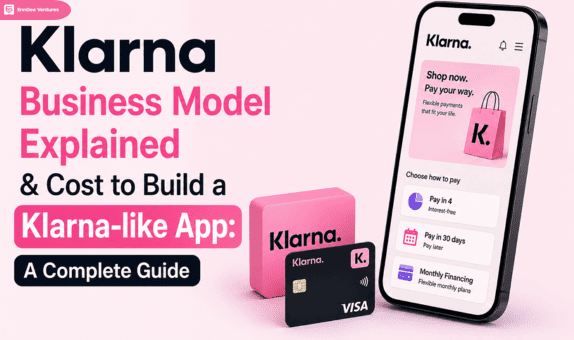
Klarna Business Model Explained & Cost to Build a Klarna-like App: A Complete Guide
Marketing Team
June 30, 2026 ∙
17 min read
In this competitive era, a brand’s success totally depends on its ability or quality which is provided to customers. The most significant development in this regard is the emergence of Buy Now, Pay Later (BNPL) services and apps such as Klarna, which have transformed the way consumers shop and represent one of the most valuable disruptions in retail history.
Shoppers can rely entirely on these apps as a payment alternative that allows them to split their purchases into easy payments, ensuring a seamless customer experience that increases customer satisfaction.
That said, to develop an easy-to-use, fully featured app, significant planning and development must take place from the user interface to secure payment options to advanced analytics. All of these come with an investment, requiring a strategic plan to be put in place.
What is Klarna and Why It’s So Popular?
At first, Klarna intended to create a sense of trust with buyers by enabling them to pay only after they had received and accepted the product, which emulated traditional mail order methods.
Klarna Overview – A BNPL Pioneer
Klarna is a fintech company based in Sweden that provides financial services for more intelligent online shopping.
The firm operates a model called Buy now Pay later. Now the firm has gone further into the neo banking space with cashbacks and balance tools.
Klarna offers various payment options, including:
Four – Part payment: This payment option allows you to divide your purchase into four easy payments, collected every two weeks, without interest, and is popular in the United States.
30 Day Payment: This option will require you to pay back the entire bill in 30 days, again without interest or late fees.
Extended monthly plans: This plan offers you the chance to pay your amount within 6 – 12 months with small payments.
Immediate Payment: This gives permission to pay the full amount at once to complete your transaction.
Here’s a clear table format for the key Klarna statistics:
Key metric
Details (2025)
Revenue
$2.5 million
Net Profit
$21 million
Active users
Over 180 million
Transaction Volume
1.45 billion
User Retention Rate
88%
Global Reach and Market Penetration
Klarna has played a pivotal role, especially in the US, UK and established as an AI first company with the percentage of tech employees they employ from 36% in 2022 to 52% by 2025.
Klarna’s app has been downloaded over 100 million times since it was launched in 2018 in numerous app stores. Likewise, the company’s potential for neobanking is with cashback programs and balanced tools.
Klarna’s Role in Modern E-commerce (GRAPHIC= VALUE IN E COMMERCE)
Klarna has secured itself among the top Buy Now, Pay Later (BNPL) brands in e-commerce. Currently, there are more than 60, 000 merchants globally, which include all major brands like eBay and Johan Lewis, who have made Klarna a payment option at checkout, enabling customers easier access to flexible payment options.
In addition, some of the largest retailers, including Amazon and Walmart, have incorporated Klarna into their payment systems, demonstrating the platform’s legitimate growth of adoption. Also, Klarna’s business allows customers to manage their finances more simply and better plans for budgets.
Klarna’s Business Model – How It Works
Klarna acts as a middleman to connect retailers to consumers with various features that enhance the payment experience. This includes an in-store checkout solution and real-time risk management capabilities that help prevent good transactions from being disrupted.
BNPL Model: Pay in 4, Pay Later, Monthly Financing (PIE CHART OF THESE )
Klarna offers various flexible payment options based on your shopping preferences:
Pay in 4: One of the most common options, paying in 4 allows users to quickly finalize checkout and pay the total bill in four installments. Each instalment will be automatically charged every two weeks.
Some highlights include:
No fees if users pay instalments on time
Automatically charged every two weeks
More flexibility in budgets
Pay Later: For larger purchasers, this option allows users to split the payment into smaller installments over the course of 6 to 24 months. Customers may receive the added benefits of a lower interest rate starting at 0% during the installments.
Monthly financing: This simple option allows you to buy and pay at a later date up to 30 days from the date of purchase.
Some highlights include:
Buy it now, pay for it in 30 days
Pay only for what you keep
No charges if you pay within 30 days
Merchant Relationships & Embedded Checkout
Klarna enables a seamless checkout experience and a more streamlined payment process. Customers also can choose from various payment options, including:
Choosing Klarna at the checkout
Using Apple Pay
Using a virtual one timecard
The Klarna Credit Card
Klarna App Experience for Users
Klarna’s app, launched in 2018, has greatly aided in expanding the company on its journey to growth. The app was designed to make everyday purchases easier, while also providing convenience to users. Below are some of its key features:
Interconnected with over 724,000 buyers and teamed up with 150,000 new retailers and partners
You can use it at checkout with various leading brands like eBay, John Lewis?
Provides discounts and shopping deals usually not available
Easy access to neobank features related to cashback and balance
Provides AI-powered fintech enhancements to be smarter about transactions
Delivers a seamless easy user process
Risk, Trust & Credit Decisions in Real Time
A robust and secure infrastructure is fundamental to apps like Klarna, and their financial management system operates on:
Quick lending decisions for every transaction
Real-time affordability checks for overspending
Leveraging AI for credit checks and fraud detection
Zero-interest payment options to lessen cash flows.
Klarna’s Revenue Streams
Revenue Stream
Share of Total Revenue
Description
Transaction & service revenue
76%
Income from merchant fees, interchange fees, affiliate commission, and services
Interest Income
24%
Earning from financing plans, Interest on long term installments and plans
Merchant Commission (Avg. 3%–6%)
At the time of each transaction, the company charges the retail partner a fee between 3% and 6% (in 2024).
To clarify, if you make a purchase on a $100 item through Klarna, the merchant receives about $97.33. Klarna retains $3–6, as part of its fee, after the consumer pays.
Interest & Late Fee Income
Klarna also makes money by adding late fees to consumers who have not paid their payments on time. The fee amount is dependent on the order value and varies by region and interest rate method selected.
Advertising & Affiliate Revenue Klarna charges interest in some situations, for instance, if a customer uses the “snooze” feature to delay a payment, or if the customer opts to repay a purchase using interest charging financing.
Similarly, Klarna also generates revenue from openly disclosed financing products, especially for products with terms of longer than three months.
Premium Financial Services (Insights, Reports)
Klarna’s premium financial services utilize sophisticated tools and data-driven solutions for merchants and shoppers alike. These services provide comprehensive insights into buying behavior, spending patterns, and transaction reporting to help merchants make informed decisions and increase efficiencies.
Features You Need in a Klarna-like App
Klarna app’s great success just after it launched can be attributed to its rich feature set, fantastic user experience, and continuous investment to maintain their smooth, all in one.
When building a Klarna-like app or any BNPL-based app in 2025, it is important to build for the future while also being in-compliance with local regulations and government guidelines.
Here are some recommended features:
User Panel
It’s essential for users to be able to verify their identity and finish the KYC process with identity documents issued by the government.
Like Klarna, think about having a variety of payment options, such as Pay in 4, Pay Later in installments, and Pay Now.
With the assistance of Klarna, users can track their order and put reminders on it so that they can set up an auto pay method on their account.
Merchant Panel
Effective integration: Easy plug-and-play integration of websites built on common eCommerce platforms (e.g. Shopify or WooCommerce) with an API integration option for custom stores. Integration allows the option to connect with a real-time inventory management system.
Sales Dashboard: Merchants should have a dashboard to view analytics related to sales, past order histories, and demographic ordering patterns.
Advanced Analytics: To be able to strategize and analyze GMV (Gross Merchandise Volume), conversion rate, and average order value while monitoring sales.
Payment Integration: Allow merchants to track and view the payment status of an order.
Order Status Tracking: To be able to track the status of order deliveries. In the case of discrepancies with a product, help and support including refunds, cancellations, or partial refunds.
Advertising Campaigns: Merchants should be able to create and monitor their Ad Campaigns, or offer the option to send promotional notifications about price drops, hot items, etc., if users opt in.
Admin Panel
Credit Scoring System: Evaluates financial history to categorize users into low, medium, or high credit risk.
Risk detection: Detects suspicious activity and issues of early alerts to prevent financial risks.
Reporting Console: Functions as a dashboard for tracking credit scores, risks, and user activity. Generates visual reports and exports data for analysis or compliance.
Payment plans customization: Can create unique payment plans to follow their business model can provide the flexibility to trend payments to customers and market obligations.
Tech Stack & Architecture Overview
Backend: Node.js / Django / Ruby on Rails
The backend is responsible for handling server-side processes including user management, authentication, algorithms, and API calls to facilitate payments and data transfer. It also takes care of user-facing services such as push notifications, reporting, security, and high-volume transactions.
Backend Framework
Remarks
Node.js
Great for real time apps, Fast, Scalable and Widely supported
Django
Secure, Reliable and comes with built in features for rapid development
Ruby on Rails
Developer friendly, quick to build MVPs, and strong community support
Frontend: React / Flutter / Swift / Kotlin
Frontend enables users and merchants to interact via apps or the web, offering easy access to services, store management, and payment transactions.
Fronted Framework
Remarks
React
Flexible, reusable, components, great for web and cross platform apps
Flutter
Single codebase for Android & iOS, Fast UI development, Smooth performance
Swift
Native iOS development, secure and optimized for apple ecosystem
Kotlin
Native Android development, Concise code, and full compatibility with Java
Database: PostgreSQL / MongoDB
Database stores users, transactions, and merchant data while managing relationships for financial compliance.
Database
Remarks
PostgreSQL
Reliable, relational database, ideal for complex queries, and financial compliances
MongoDB
Flexible, document-based NoSQL database, great for handling unstructured data and scalability
How a BNPL App Like Klarna Works (Step-by-Step Flow)
The user browses a partnered online store and chooses a product to purchase.
Users select Klarna’s payment option that suits them, such as paying later in full, installments, or through longer-term financing.
Klarna quickly verifies the user’s eligibility and risk profile before approval.
Klarna pays the merchant immediately, ensuring cash flow for the seller.
The user repays Klarna according to the chosen plan, either in parts or in full later.
The system sends reminders, processes auto-payments, and applies late fees when necessary.
Admins use a dashboard to track payments, detect fraud, monitor credit risk, and review user activity for compliance and improvement.
Klarna-like App Development Cost Breakdown
UI/UX Design (User + Merchant + Admin): Designing intuitive and engaging interfaces for all users will cost 6000 to 10000 dollars and timeline 2 to 3 weeks.
BNPL Logic & Credit System Integration: Building core Buy-Now-Pay-Later functionality with instant credit checks with cost 10000 to 18000 dollars and timeline 3 to 5 weeks.
Payment Gateway & Fraud Detection: Enabling secure payments and fraud prevention will cost 7000 to 12000 dollars and timeline 2 to 3 weeks.
Merchant Dashboard: Creating tools for merchants to manage sales and performance with a cost of 4000 to 7000 dollars and a timeline of 2 weeks.
Admin Portal & Reporting: Providing a dashboard for real-time insights and system control with cost 5000 to 8000 dollars and timeline 2 to 3 weeks.
KYC/AML Compliance Engine: Ensuring identity verification and regulatory compliance with cost 8000 to 12000 dollars and timeline 3 to 4 weeks
Notifications, Alerts & Reminders: Keeping users informed and improving payment adherence with cost 2000 to 4000 dollars and timeline 1 week.
Testing, QA & Launch: Ensuring a smooth, bug-free launch with cost 5000 to 7000 dollars and timeline 2 to 3 weeks.
Estimated Total: MVP costs 47000 to 78000 dollars with a timeline of 8 to 12 weeks. A full product costs 90000 to 140000 plus dollars with a timeline of 14 to 20 plus weeks.
Klarna’s Competitors and Market Trends
Key Players – Afterpay, Affirm, Sezzle, Zip
Key Players
Description
After pay
Buy – Now – Pay – Later service offering interest free installment payments
Affirm
Flexible financing platform with transparent terms and no hidden fees.
Sezzle
Short-term installment payment solution with easy approval and no interest.
Zip
Global BNPL platform enables flexible payments and instant credit access.
Klarna’s Shopping + BNPL Differentiator
Feature
Description
Seamless Shopping experience
Smooth, User-friendly interface integrated with partner stores
Flexible payment options
Pay later, pay in 4 or financing tailored to customer needs.
Instant credit checks
Quick risk assessment for fast approvals.
Boosted conversions
Simplified checkout increases sales for merchants.
Customer Loyalty
Flexible payments and transparency enhance trust and repeat purchases.
2026 Trends – AI Credit Decisions, Crypto Checkout, BNPL Subscriptions
2026 Trends
Description
AI credit decision
Using AI to instantly assess credit risk for faster, more accurateapprovals
Crypto Checkout
Allowing payments via cryptocurrencies for global secure and instant transaction
BNPL Subscription
Recurring Buy now pays later modules for subscription-basedservices and products.
Timeline to Build a Klarna-like App (SIMPLE MENTION NAME WITH DESIGN)
The timeframe to create an app similar to Klarna relies on the app structure, its level of complexity, and the tech stack chosen by developers. The stages and timelines for Klarna app development are outlined here.
Discovery & Requirements – 2–3 weeks
Structuring the main idea regarding an app’s features & requirements is the first and most difficult part of the process. This part includes building a framework, determining the app’s complexity, and including certain features.
This part will also include a discussion about choosing the right tech stack after consulting professionals.
That is why, when it comes to the app you want to build, it is important to consult with a team of professionals who have experience with the following:
Defining app scope
Help you establish the target audience
Knowing financial regulations
Marketing strategies to increase revenue
And technologies of stacks as previously discussed.
Depending on complexity, the discovery and requirement part may vary from 2-3 weeks.
UI/UX & Architecture – 3–4 weeks
UI/UX plays a key role in:
Attraction (new customers: buyers + merchants)
Retention
Usage
Experience
So, while creating a UI/UX wireframe (or detailed Figma), it’s best to keep 2-3 different prototypes in front of you. Ultimately, you can even do some A/B testing with potential customers to gauge which one is more productive.
In addition to the UI/UX wireframe, I also plan out the database schema to pin relations.
Development (Core Modules) – 8–12 week
In this phase, the entire app is developed and ready for final testing. Development time is affected by team size, which may mean a smaller team will deliver a project over an extended timeline, but a larger team can get it done quickly and accurately.
Also, since all the professionals at a professional Klarna like app development company are dedicated to your project, they are able to fuel the entire stage efficiently.
Depending on the level of complexity of the app and team size, Klarna-like app development may take anywhere between 8-12+ months.
Estimated time for MVP, i.e., Core modules (Minimum Viable Product) – 8-12 months.
Moderate and Advanced features may take up to 12-24 months.
Testing & Launch – 2–3 weeks
After your application is developed, you will need to arrange for comprehensive testing. This includes at least one live execution. You should conduct a thorough security test on the integrity of users’ data as well as the security of transaction processing.
Having completed your testing, you are in a position to launch either broadly or engage in a narrowed launch with selective merchants.
Post-Launch Support – Ongoing
Post-launch support remains active as long as your app is live and operational. This encompasses bug correction, ongoing monitoring of existing features, AI model training to create a more secure environment, and research and development for new features.
Why Klarna-like Startups Are Thriving in the USA
The global BNPL market is anticipated to increase from USD 51.74 billion in 2025 to USD 435.25 billion by 2033, according to a study published by Straits Research.
Additionally, Klarna is among the top BNPL fintech service providers in the United States. Consumers are seeking more convenient payment methods and greater control over their spending and budgeting, according to changing buying trends.
That is precisely what Buy-Now-Pay-Later-based fintech service providers offer. It makes it possible for customers to purchase pricey goods without facing significant financial hardships.
The following arguments examine the reasons for the success of businesses like Klarna in the United States:
Millennials & Gen Z Prefer Flexible Payment
Millennials and Gen Z want payment methods that are more open and flexible. The current generation is embracing and rapidly adjusting to this market since BNPL procedures offer interest-free installments and increased self-control over spending.
Additionally, BNPL businesses like Klarna tackle the problem of debt revolving, which improves budgeting and lessens financial strain.
Embedded Finance for E-commerce Growt
Klarna has already demonstrated that BNPL integration opens the way to a new financial market order.
Spending increases because of BNPL, which raises cart conversion.
Klarna is a prime example of how BNPL companies may achieve enormous success by collaborating with e-commerce behemoths like DoorDash or eBay.
Huge Scope for Niche BNPL (Healthcare, Education, Travel
Klarna is looking into new methods to incorporate its BNPL model into a variety of services, including the more basic ones like tuition, travel booking, and medical costs.
By offering efficient solutions driven by AI and ML modules, BNPL also has the ability to access the financial ecosystem.
As BNPL financial services continue to be integrated with web3 and crypto technologies, users can anticipate a more seamless and varied experience than before.
It wouldn’t be incorrect to anticipate that BNPL will soon expand beyond retail locations.
Work With Us – Your BNPL App Development Partner
A company’s foundation determines its success.
It takes skilled developers who can manage every phase of development and complement your business vision to create a BNPL app like Klarna.
Since 2005, EnnGee Ventures has been providing enterprise-grade solutions, with a focus on BNPL applications, investment apps, neobanks, and secure payment systems that utilize the newest blockchain technology.
What We Deliver
MVP in 10–12 weeks ensures a functional app launch within three months.
PCI-DSS, GDPR, SOC2 readiness guarantees compliance, security, and data protection.
Agile-based delivery with risk engines enables fast development and smart risk management.
Book a Free Strategy Session
Receive a customized price with a detailed project plan that includes the option to scale into more complex features and an MVP in 10–12 weeks.
Final Thoughts – Klarna as a Business Model Blueprint
Klarna Proves BNPL is Scalable & Profitable
According to Klarna’s business model, build smart, start learning, and grow quickly. The most prominent illustration of the BNPL business model today is the fintech startup concept that investors first rejected.
Klarna has demonstrated that the BNPL model is scalable and profitable when applied methodically and combined with options that are prepared for the future.
As we covered in the aforementioned case study, offering more complete financial solutions is where this company model’s future rests. As demonstrated by Klarna’s success story, fintech businesses may increase customer trust by granting users greater control over their financial management. This will ultimately be very advantageous.
Future Lies in Embedded Finance + User Trust
The future of BNPL apps is being shaped by embedded finance, which makes it possible for lending, investments, and payments to be smoothly integrated into regular platforms. However, establishing user trust via open credit checks, safe payments, and regulatory compliance is equally important for success.
Start Lean, Build Smart, Grow Fast
It doesn’t have to be difficult to launch a Klarna-like app; start small with an MVP to test the market, develop smart with scalable architecture and compliance built in, and expand quickly by incorporating partnerships, cutting-edge features, and user-focused innovations.
FAQs
What is Klarna's business model
Buy-Now-Pay-Later is the foundation of Klarna, wherein the fintech business serves as a middleman between buyers and sellers, paying merchants upfront for purchases and then collecting from customers in accordance with the selected plan (Pay in 4, Pay in 30, Pay overtime, etc.).
How does Klarna make money from merchants and users?
Businesses: Klarna adds a merchant fee, sometimes known as a “take rate,” to every order. 2.7% by 2024! Users/Consumers: income is derived from consumer-facing services (such as card interchange and premium features), late/returned-item fees for some goods, and interest in multi-month financing programs.
What features are required in a BNPL app like Klarna?
User: onboarding + KYC, campaign/ads tools, payouts/settlement dashboard, dispute & returns handling, easy integrations (Shopify/WooCommerce/API), and different payment alternatives (Pay in 4, Pay in 30, financing).
Admin/Ops: compliance with banking regulations, robust encryption, and merchant and user administration.
How much does it cost to build a Klarna-like app?
The price range for developing a Klarna-like BNPL app is $47K to $78K, and it can be completed in 8–12 weeks. However, the more sophisticated features might cost between $9k to $140k.
Can a startup build a similar BNPL platform in the USA?
Yes, it is feasible both commercially and technically. A similar BNPL platform can be constructed with careful planning and a productive team.
What are the compliance requirements for BNPL apps?
KYC/AML, PCI-DSS card security, and, if relevant, data protection regulations such as the CCPA or GDPR must all be implemented by BNPL apps.
What tech stack does Klarna use?
Klarna makes use of both custom-built systems and cloud-based technologies. The tech stack of Klarna is:
Python, Node.js, React, Typescript, GraphQL, AWS Lambda, Erlang, Amazon EC2, and Scala are the tools and data used in this application.
Services: Overflow in Stacks
Business Tools: Slack, Jira, G Suite, Confluence, Bitbucket, Sentry, AWS Elastic Load, Datadog, and DevOps
What is the best payment gateway for BNPL apps?
Nexi, J.P. Morgan Payments, Worldpay, Stripe, or Adyen. The framework and build of your app determine the payment gateway to use.
How long does it take to develop a Klarna-style app?
Three to six months with a dedicated cross-functional team (product, two to four engineers, one data scientist, QA, and devops) for the core MVP (user + merchant checkout + basic underwriting).
Affirm, PayPal (Pay in 4 / Pay Later), After Pay (Block), and Zip / Sezzle are some of the main rivals (both domestic and international).
What is the difference between Klarna and After pay?
While Afterpay has traditionally concentrated on the Pay-in-4 short installment product, Klarna offers a variety of solutions, including Pay in 4, Pay in 30, longer-term financing, Klarna Card, and neo banking features.
Can I build a Klarna-like app for the niche industry?
Indeed, BNPL verticalizes easily. The ability to customize underwriting, product conditions, and partnerships to the cash flows and seasonality of the vertical makes niche BNPL markets, such as travel, healthcare, education, and subscriptions—appealing.
Explore More Insights
Dive into more expert perspectives, trends, and helpful resources.
App Development
Top 12 Entertainment App Development Companies in 2026
The entertainment app market in 2026 is expanding at a rapid pace, fueled by the growing demand for streaming, gaming,…
Marketing Team
July 27, 2026 ∙
32 min read
App Development
Top 12 Education App Development Companies in 2026
The market for educational apps in 2026 is booming, as a direct result of the increased need for online learning,…
Marketing Team
July 24, 2026 ∙
29 min read
App Development
Top 12 Healthcare App Development Companies in 2026
Enn gee venture is a leading mobile app development company delivering innovative healthcare app solutions for modern healthcare providers. The healthcare app development…