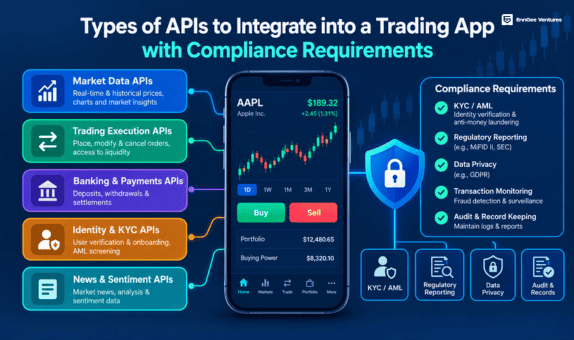
Types of APIs to Integrate into a Trading App with Compliance Requirements
Marketing Team
October 13, 2026 ∙
14 min read
Understanding APIs in Trading Applications
APIs connect trading apps with brokers, exchanges, payment gateways, market data providers, and compliance systems. They help trading platforms exchange data, execute transactions, verify users, and meet security and regulatory requirements.
What Is an API?
An API (Application Programming Interface) allows different software systems to communicate. In trading apps, APIs can connect the platform with brokers, exchanges, payment services, and KYC providers.
Why APIs Are Important for Trading Apps
APIs help trading apps provide essential functions such as real-time market data, order execution, payments, user verification, portfolio management, and compliance monitoring.
How APIs Work in a Trading Platform
When a user performs an action, the app sends a request through the relevant API. The connected service processes the request and returns the required data or transaction status to the trading platform.
Key API Requirements for Trading Applications
Trading APIs should offer secure authentication, encryption, fast performance, error handling, audit logs, data protection, and compliance with applicable financial regulations.
Types of APIs to Integrate into a Trading App
Trading apps use different APIs to handle market data, trading, user accounts, payments, security, and compliance. The required APIs depend on the platform’s features, asset classes, and target market.
Market Data APIs
Provide live and historical financial data, including prices, volumes, market trends, and other trading information.
Trading and Order Execution APIs
Enable users to place, modify, and cancel orders while connecting the app with brokers or trading systems.
Broker APIs
Connect the trading app with brokerage platforms to access accounts, market data, and trading services.
Exchange APIs
Connect directly with supported exchanges for market data, order submission, and trade execution.
Portfolio Management APIs
Provide portfolio data such as holdings, asset allocation, profit and loss, and performance.
Account Management APIs
Handle account balances, positions, transaction history, and other user account information.
Authentication APIs
Manage secure login, user authentication, authorization, and session access.
KYC APIs
Help verify customer identity and support regulatory requirements during account onboarding.
AML APIs
Screen users and transactions for potential money laundering risks, sanctions, and other financial crime concerns.
Payment and Banking APIs
Support deposits, withdrawals, bank transfers, and other payment-related activities.
Notification APIs
Send trade confirmations, price alerts, account updates, and security notifications through email, SMS, or push notifications.
Fraud Detection APIs
Identify unusual account activity and transaction patterns that may indicate fraudulent behavior.
Transaction Monitoring APIs
Monitor financial transactions and flag activity that may require compliance review.
Market Data APIs for Trading Apps
Market data APIs supply the information traders need to monitor markets and make trading decisions.
Real-Time Market Data APIs
Deliver live prices, quotes, volumes, and other market information with minimal delay.
Historical Market Data APIs
Provide previous price and trading data for research, analysis, backtesting, and reporting.
Stock Price APIs
Return current or historical stock prices, price changes, and related market information.
Market Depth and Order Book APIs
Provide bid and ask levels, available quantities, and order-book information.
Financial News APIs
Deliver financial news, company updates, and market-related information that can support trading analysis.
Trading and Order Execution APIs
Trading APIs allow the application to communicate with brokers or exchanges to manage user orders and executions.
Buy and Sell Order APIs
Allow users to submit buy or sell orders for supported financial instruments.
Market Order APIs
Execute trades at the best available market price at the time of execution.
Limit Order APIs
Allow traders to specify the maximum purchase price or minimum selling price.
Stop-Loss Order APIs
Help trigger an order when an asset reaches a specified price level.
Order Cancellation APIs
Allow eligible pending orders to be cancelled before execution.
Trade Execution APIs
Transmit orders to the relevant trading system and return execution details and status.
Broker and Exchange APIs
Broker and exchange integrations connect the trading app to external financial markets and execution infrastructure.
Broker API Integration
Enables communication between the app and brokerage systems for accounts, orders, positions, and trading data.
Exchange API Integration
Provides direct connectivity with supported exchanges for market data and trading operations.
Direct Market Access APIs
Allow eligible trading platforms to send orders directly to market venues through authorized connectivity.
Multi-Broker API Integration
Connects one trading app with multiple brokers, allowing users to access different brokerage services from a single interface.
Exchange Connectivity Requirements
Exchange integrations may require approved connectivity, authentication, market data permissions, technical specifications, and compliance with exchange rules.
KYC and AML APIs for Trading Apps
KYC and AML APIs help trading platforms verify users, screen financial risks, and meet applicable compliance requirements during onboarding and ongoing account activity.
KYC Verification APIs
Automate customer verification by collecting and validating required user information during account registration.
Identity Verification APIs
Confirm a customer’s identity using personal information and approved verification methods.
Document Verification APIs
Check identity documents such as passports, driving licences, or other permitted documents for authenticity.
AML Screening APIs
Help identify customers or activities that may present money laundering or financial crime risks.
Sanctions Screening APIs
Check customers against applicable sanctions and restricted party lists.
PEP Screening APIs
Identify politically exposed persons who may require additional risk assessment or monitoring.
Transaction Monitoring APIs
Monitor transactions for unusual patterns and activities that may require further investigation.
Regulatory Compliance Requirements for Trading APIs
Trading API integrations must follow the regulations applicable to the platform, users, financial products, and operating jurisdictions.
SEC Compliance Requirements
US trading platforms may need to follow SEC requirements covering areas such as investor protection, reporting, records, and market activities.
FINRA Compliance Requirements
Broker dealers and other regulated firms may need to meet FINRA requirements related to supervision, trading activity, communications, and recordkeeping.
MiFID II Compliance Requirements
Trading platforms operating within applicable European markets may need to address requirements covering transparency, transaction reporting, investor protection, and recordkeeping.
GDPR and Data Protection Requirements
Apps handling personal data should apply appropriate data protection, security, access, consent, and retention practices where GDPR applies.
AML Compliance Requirements
Platforms may need controls for customer screening, transaction monitoring, suspicious activity detection, and reporting.
KYC Compliance Requirements
KYC processes should verify customers and collect the information required under applicable financial regulations.
Recordkeeping and Audit Requirements
Trading systems should maintain appropriate records of orders, transactions, user activity, and compliance actions for required periods.
Authentication and Authorization APIs
Authentication APIs protect trading accounts and control access to sensitive financial functions.
API Key Authentication
API keys identify applications or services when communicating with an API.
OAuth 2.0 Authentication
OAuth 2.0 enables controlled access to resources without sharing a user’s primary login credentials.
JWT Authentication
JWTs can securely transmit authentication and authorization information between systems.
Multi-Factor Authentication APIs
MFA APIs add additional verification steps, such as OTPs or authenticator-based verification.
Role-Based Access Control
RBAC limits system access according to user roles and permissions.
Payment and Banking APIs
Payment and banking APIs connect trading apps with financial institutions and payment services for funding and withdrawals.
Payment Gateway APIs
Process supports online payments and account-funding transactions.
Bank Account Verification APIs
Verify bank account details before deposits or withdrawals.
Open Banking APIs
Connect eligible financial services with bank account information and payment capabilities through authorized providers.
Deposit APIs
Enable users to add funds to their trading accounts.
Withdrawal APIs
Process requests to transfer available funds from trading accounts.
Fund Transfer APIs
Support transfers between connected bank accounts and trading accounts.
Security Requirements for Trading API Integration
Security controls help protect trading data, accounts, transactions, and API connections from unauthorized access.
Data Encryption
Encrypt sensitive data during transmission and storage using appropriate security standards.
Secure API Authentication
Use strong authentication and authorization methods to protect API access.
API Rate Limiting
Limit API requests to reduce abuse, overload, and certain automated attacks.
API Gateway Security
Use an API gateway to manage authentication, traffic filtering, monitoring, and access policies.
API Key Management
Store, rotate, restrict, and revoke API keys securely.
Audit Logging
Record important API requests, transactions, authentication events, and administrative actions.
Fraud Detection and Monitoring
Monitor account and transaction activity to identify suspicious or potentially fraudulent behavior.
How to Integrate APIs into a Trading App
API integration should combine technical implementation with security and regulatory planning.
Define Trading App Requirements
Identify trading features, supported assets, users, markets, and required integrations.
Identify Regulatory Requirements
Determine the financial, KYC, AML, data protection, and reporting obligations that apply.
Select API Providers
Compare providers based on functionality, security, compliance support, documentation, performance, and pricing.
Design the API Architecture
Plan how market data, trading, payment, authentication, and compliance APIs will communicate.
Implement Authentication and Security
Add secure authentication, authorization, encryption, access controls, and monitoring.
Integrate Market Data APIs
Connect with approved market data sources to display prices, charts, volumes, and related information.
Integrate Trading APIs
Connect brokers or exchanges to support order placement, modification, cancellation, and execution.
Integrate KYC and AML APIs
Add identity verification, document checks, sanctions of screening, and AML monitoring.
Integrate Payment APIs
Connect payment or banking services for deposits, withdrawals, and fund transfers.
Test API Integrations
Test functionality, security, performance, error handling, and compliance workflows before launching.
Deploy and Monitor APIs
Deploy the integrations and continuously monitor performance, errors, security events, and regulatory changes.
REST APIs vs WebSocket APIs for Trading Apps
REST and WebSocket APIs serve different purposes in trading applications.
What Are REST APIs?
REST APIs use request-and-response communication and are commonly used for account operations, order management, and retrieving data.
What Are WebSocket APIs?
WebSocket APIs maintain a persistent connection, allowing servers to send real-time updates to the trading app.
REST APIs vs WebSocket APIs
REST works well for individual requests, while WebSocket is better for continuous real-time updates such as prices and order status.
When to Use REST APIs
Use REST for account information, order submission, order cancellation, and historical data requests.
When to Use WebSocket APIs
Use WebSocket for live prices, market updates, order-book changes, and real-time trade notifications.
How to Choose the Right Trading API Provider
Choosing an API provider requires evaluating both technical capabilities and compliance considerations.
API Reliability and Uptime
Check historical availability and the provider’s approach to service interruptions.
API Security and Compliance
Review authentication, encryption, data handling, security controls, and relevant compliance practices.
API Documentation and SDK Support
Good documentation and SDKs can simplify development and troubleshooting.
API Performance and Latency
Evaluate response times and data delivery speed, especially for trading and market data functions.
Scalability and API Limits
Check out request limits, connection limits, and whether the API can support expected traffic.
API Pricing and Costs
Compare subscription fees, usage charges, market data costs, transaction fees, and other integration expenses.
Common Challenges in Trading API Integration
Trading API integrations can face technical, operational, and regulatory challenges.
API Downtime
Provider outages can interrupt market data, order processing, or other trading functions.
High API Latency
Delayed API responses can affect real-time data and order-related operations.
Data Synchronization Issues
Differences between systems can cause inconsistent accounts, portfolios, or transaction data
API Rate Limits
High request volumes may exceed provider limits and interrupt application functionality.
Third-Party API Dependencies
Reliance on external providers can create operational risks if their services change or become unavailable.
Regulatory Changes
New financial, privacy, or reporting requirements may require updates to API integrations and compliance with workflows.
Security Vulnerabilities
Weak authentication, exposed API keys, insecure endpoints, or poor access controls can increase security risks
Testing and Monitoring Trading APIs
Testing and monitoring help ensure trading APIs work correctly, securely, and consistently after integration.
Functional API Testing
Checks whether APIs perform actions such as retrieving data, placing orders, and updating accounts correctly.
Security Testing
Identifies vulnerabilities in authentication, authorization, data transmission, and API endpoints.
Performance Testing
Measures API response times, request capacity, and performance under high traffic.
Compliance Testing
Verifies that API workflows follow applicable KYC, AML, data protection, and financial regulations.
API Monitoring
Tracks API availability, response times, errors, and unusual activity in real time.
Error and Incident Management
Helps detect, investigate, and resolve API failures, security incidents, and service disruptions.
Cost of API Integration in a Trading App
API integration costs depend on the number of APIs, provider pricing, trading features, security requirements, and compliance needs.
Factors Affecting API Integration Cost
Key factors include API complexity, development time, provider fees, data volume, security, and maintenance requirements.
Market Data API Costs
Costs may include provider subscriptions, usage fees, exchange licensing, and access to premium market data.
Trading API Costs
Trading API expenses can include provider charges, transaction fees, and broker or exchange connectivity costs
KYC and AML API Costs
Providers may charge per verification, screening request, or through monthly subscription plans.
Payment API Costs
Payment integrations may involve setup fees, transaction charges, or provider-specific usage costs.
Security and Compliance Costs
Expenses can include security testing, compliance tools, audits, monitoring, and specialist support
Ongoing API Maintenance Costs
Maintenance covers API updates, security patches, provider changes, monitoring, troubleshooting, and compliance updates.
Best Practices for Compliant Trading API Integration
Following security and compliance practices help reduce operational risks and support regulatory requirements.
Follow a Compliance-First Approach
Identify applicable regulations and compliance requirements before selecting and integrating APIs.
Use Secure Authentication
Use strong authentication, authorization, and access controls for every sensitive API operation.
Protect Sensitive Financial Data
Encrypt financial and personal data and restrict access to authorized systems and users.
Maintain Complete Audit Trails
Keep appropriate records of orders, transactions, API activity, and compliance-related actions.
Monitor Transactions Continuously
Use transaction monitoring to identify unusual activity and potential financial-crime risks.
Regularly Update APIs and Security Systems
Apply provider updates, security patches, and changes required to maintain secure integrations.
Conduct Regular Compliance Audits
Review API workflows, security controls, records, and compliance processes regularly to identify gaps and required improvements.
Future Trends in Trading APIs
Trading APIs are evolving with AI, real-time data, digital assets, open banking, and automated compliance. These developments can help trading platforms improve automation, risk controls, and regulatory processes.
AI-Powered Trading APIs
AI-powered APIs can support market analysis, trading insights, portfolio optimization, and automated decision support.
Real-Time Risk Management APIs
These APIs can monitor positions, exposure, margin, and market conditions in real time to support faster risk decisions.
Blockchain and Digital Asset APIs
Blockchain APIs connect trading platforms with cryptocurrency networks, digital asset exchanges, wallets, and transaction services.
Open Banking APIs
Open Banking APIs allow authorized platforms to connect with banking services for account information and payments.
RegTech APIs
RegTech APIs help automate compliance activities such as monitoring, reporting, screening, and regulatory checks
Automated Compliance APIs
These APIs can automate KYC, AML, sanctions of screening, transaction monitoring, and compliance alerts.
Conclusion
APIs are essential for connecting trading apps with market data, brokers, exchanges, payment services, and compliance systems. Choosing secure and regulation-compatible APIs can help create a reliable trading platform while supporting applicable financial and data protection requirements
Frequently Asked Questions
What types of APIs are required to build a trading app?
Common APIs include market data, trading, broker, exchange, KYC, AML, payment, authentication, portfolio, and notification of APIs.
Which API is used for real-time stock market data?
Real-time market data APIs provide livestock prices, quotes, volumes, and other market information.
What is the difference between trading APIs and market data APIs?
Trading APIs handle orders and execution, while market data APIs provide financial information such as prices and market activity.
Do trading apps need KYC and AML APIs?
Trading platforms may need KYC and AML capabilities to meet applicable customer verification and financial-crime compliance requirements.
How do APIs help trading apps meet compliance requirements?
APIs can automate identity verification, sanctions of screening, transaction monitoring, recordkeeping, and other compliance processes.
Are REST APIs suitable for trading applications?
Yes. REST APIs are suitable for functions such as account management, order requests, and retrieving historical data.
Why are WebSocket APIs important for trading apps?
WebSocket APIs support continuous, real-time data updates, making them useful for live prices, order books, and trade notifications.
How can trading APIs be secured?
Use strong authentication, encryption, access controls, API key management, rate limiting, monitoring, and audit logging.
What regulations apply to trading app API integration?
Requirements depend on the country, financial products, business models, and regulatory status. They may include securities, AML, KYC, data protection, and recordkeeping requirements.
How much does it cost to integrate APIs into a trading app?
Costs vary based on API providers, features, usage, market-data licensing, security, compliance, and development requirements.
How long does trading API integration take?
Basic integrations may take weeks, while platforms requiring multiple brokers, exchanges, payments, and compliance systems can take several months.
How do I choose the right API provider for a compliant trading app?
Evaluate the provider’s security, compliance support, documentation, reliability, latency, API limits, pricing, and compatibility with your target market.
Explore More Insights
Dive into more expert perspectives, trends, and helpful resources.
Software Development
How to Choose the Best Custom Software Development Company in USA
Enn Gee Ventures helps companies create custom software solutions that match their goals, their daily work processes and their technology…
Marketing Team
October 21, 2026 ∙
18 min read
AI
Elementi duplicati in Maccy: perché compaiono e come eliminarli
Elementi duplicati in Maccy: perché compaiono e come eliminarli Risposta rapida: di norma Maccy unisce le copie identiche in una…
developer
October 20, 2026 ∙
8 min read
AI
Maccy Duplicate Items: Why They Appear and How to Stop Them
Maccy Duplicate Items: Why They Appear and How to Stop Them Quick answer: Maccy normally merges identical copies into one…