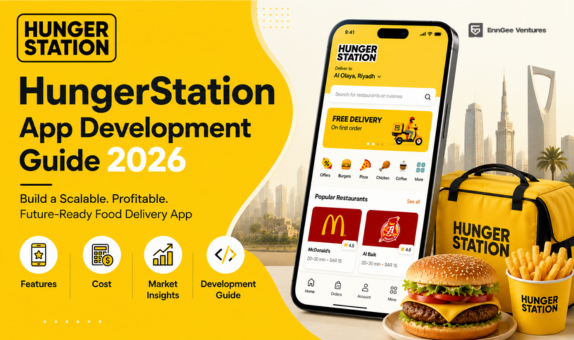
The global food delivery market is thriving like never before — expected to surpass $500 billion by 2026. What was once a convenience has transitioned into an essential service that blends technology, customer experience, and real-time logistics into one seamless experience.
In this growing vertical, Hungerstation like app cost stands as a market leader in Saudi Arabia (KSA), connecting millions of customers with thousands of restaurants, cafés, and grocery stores. With the strong backing of Delivery Hero, its efficient delivery operations, intuitive design, and reliable payment systems have positioned it as one of the most successful food delivery apps in the Middle East.
For startups and investors, building apps like Hungerstation is not just an app but a proven business model. Its success has sparked massive interest among entrepreneurs aiming to build an app like HungerStation and tap into this rapidly expanding digital ecosystem. The growing curiosity about the HungerStation-like app cost highlights a strong demand for understanding how to replicate its success in 2026.
The big question is — what is the actual food delivery app cost to create a similar scalable solution? Or more specifically, how much would a full-featured HungerStation clone cost in today’s competitive app development market?
In this complete 2026 guide, we’ll unpack everything you need to know before investing in food delivery app development — including cost models, key features, monetization strategies, timelines, tech stack, and competitor analysis to help you make an informed decision.
HungerStation Insights
What is Hungerstation?
HungerStation is an online food and grocery delivery platform in Saudi Arabia. It is recognized as one of the first and largest platforms of its kind in the Kingdom. Since it launched in 2012, it has been a subsidiary of Delivery Hero, a global leader in food delivery.
HungerStation’s platform connects customers to a myriad of restaurants and grocery stores. This makes the process of ordering and receiving food completely seamless.
With features that are easy to use and enjoyable, HungerStation makes ordering food quick, easy, and fun.
Market Positioning Compared to Competitors: Talabat, UberEats, and Deliveroo
As a food delivery app, HungerStation has an interesting and unrivaled position. Global players like UberEATS and Deliveroo have the benefits of being well-known to international brands and access to cutting edge technology, while HungerStation takes a position related to localization, dependability and regional specificity.
- Talabat is a Middle Eastern food delivery app that is in the same competitive segment as HungerStation, especially within GCC markets. Yet, Talabat is currently a multi-country app as a part of the Delivery Hero organization, while HungerStation remains KSA-first, with a strong central focus on hyperlocal delivery operating, which suits Saudi consumer behavior.
- UberEats has the upper hand as a global brand but was unable to replicate the same success in Saudi Arabia. HungerStation’s understanding of delivery and logistics, partnership in local industry, and a large driver network, created advantages for HungerStation which international apps do not share.
- Deliveroo is successful in the UAE and parts of Europe and focuses on delivering high-end, dining opportunity experiences. HungerStation provides a blended ecosystem of experiences from quick meals to premium dining to authentically deliver a complete food delivery experience.
Key Drivers of HungerStation’s Success
HungerStation collaborates with thousands of restaurants, cafes, and grocery stores in KSA, providing customers with endless alternatives for dining choices.
- Extensive Restaurant Network: HungerStation partners with a wide array of restaurants, cafes, and supermarkets in Saudi Arabia to give users a variety of food options with fast delivery.
- User-Friendly App: The app has an easy-to-use interface, live updates, and secure payment options to create a seamless and user-friendly ordering experience.
- Sophisticated Delivery Logistics and Tracking: Using modern GPS tracking systems and optimized routing for delivery helps keep your consumers happy and reduces friction with the delivery driver.
- Loyalty Programs: Setting up rewards and promotions can help maintain long-term customer loyalty and add value to your business.
Why Businesses Invest in HungerStation Clones
HungerStation’s extraordinary journey, success and prominence has motivated a new generation of entrepreneurs to enter the lucrative food delivery space. HungerStation has a track record of scalability and worldwide adoption, thus making this the ideal model and roadmap for startups developing a path of long-term growth.
- Proven Revenue Model: HungerStation has developed a revenue model based on commissions, delivery fees and promotional partners requiring consistent and profitable revenue streams.
- Strong Demand in MENA, the USA, Europe, and Asia: Globally, consumer demand for food delivery continues to grow which presents significant opportunities in both developed and developing nations.
- Increasing Smartphone Penetration: The rising number of mobile-first consumers daily means ordering food through an app has become the standard approach by consumers prioritizing convenience.
Cost to Develop a HungerStation-Like App in 2026
Quick Snapshot
- Basic MVP: This is the minimum viable product (MVP) to test your idea in the marketplace. This MVP includes user registration, basic restaurant listings, order placement, and basic payment integration.
- Mid-range: A more sophisticated app with advanced searching, multiple forms of payment, rates and reviews, live tracking, and in-app notifications. Perfect for a start-up looking to improve user engagement and retention.
- Advanced clone: A comprehensive and high-quality duplicate of HungerStation including AI-driven recommendations, loyalty programs, numerous delivery methods, and expandable architecture. This is suitable for large operations with concepts of more than 1 region and more than 1 area.
| App Type |
Cost (USD) |
Best for |
| MVP |
$20,000 – 40,000 |
Startup testing market |
| Mid- tire |
$40,000 – 80,000 |
Growing business |
| Advanced |
$100,000 – 200,000 |
Enterprise level scaling |
Reasons Behind Cost Variation
- Custom vs White-Label Solutions: The cost of building an entirely custom app is substantially higher due to the expertise required for custom UI/UX design, custom backend development, and consideration for scalability.
- Feature Sets: The complexity and amount of features greatly influence cost. Features like real-time order tracking, AI-based recommendations, and multi-vendor enablement will always require more development time – and investment.
- Development Region: Development costs vary according to your tech partner’s location. North America and Western Europe generally charge higher rates, while developers in Asia and Eastern Europe are more competitively priced and provide similar quality.
Key Features of a HungerStation-Like App H3: Customer App Features
- Account Creation & Social Login: Users can rapidly create an account using email, phone, or social media accounts to easily get to the start of the experience.
- Restaurant Listings & Filters: Browse restaurants, cuisines, and dishes along with simple search and filter features.
- Real-Time Order Tracking: Customers track their order in real time from restaurant preparation until delivery for maximum visibility and transparency.
- Reviews & Loyalty Rewards: Users review restaurants, provide feedback and earn points or rewards for reordering to build loyalty.
Restaurant Panel
- Menu Upload and Management: Simple to add, edit, delete menu items and price changes/ specials.
- Order Dashboard: Monitor incoming order status in real time and track cooking status and delivery updates easily.
- Insights and Revenue Reports: Have access to analytics of business sales, popular dishes and revenue to improve informed decisions.
Delivery Agent App
- GPS Navigation: Offers delivery partners with real-time route navigation to facilitate fast and accurate deliveries. Optimizes travel time and improves efficiency overall.
- Order Acceptance/Rejection: Allows delivery partners to accept or decline orders based on availability, location, or workload. Ensures workflow manageability and minimizes instances of delayed delivery or service.
- Wallet & Earnings Reports: Tracks earnings, incentives, and completed deliveries inside a digital wallet. Aids transparency and simplifies delivery partner financial management.
Admin Panel
- Management of restaurants/drivers: Allows administrators to easily manage restaurants and delivery drivers. Simplifies onboarding, scheduling, and performance monitoring, ensuring everything runs smoothly.
- Settlement of payment: Automates payments for restaurants and delivery partners. Ensures payments are always on time, accurate payments, and reduces manual errors.
- Dashboard analytics: Provides real-time insights into orders, revenue, and users. Helps you make data-driven decisions to improve your business operations.
Advanced AI Features (Add-on Costs)
- Personalized food recommendations: It is powered by AI to suggest foods and restaurants based on user preferences and previous purchases.
- AI-Powered Chatbots: Boost customer service effectiveness by providing prompt assistance and responding to commonly asked questions.
- Fraud Detection: By quickly spotting suspicious transactions or activity, fraud detection maintains payment of security and confidence.
- Predictive delivery times: This uses machine learning to generate accurate delivery time estimates based on order volume, traffic, and location.
Detailed Module Cost Breakdown
Several modules are needed to build a food delivery app like Hungerstation, and each one improves user experience, business control, and operational effectiveness. The features, scale, and technology employed all affect the overall cost of th
e food delivery app.
- Customer App ($8,000 – $20,000)
- Includes restaurant browsing, food ordering, and payment options.
- Focuses on a smooth user experience and fast order processing.
- Ideal for startups aiming to launch a scalable customer platform.
- Restaurant App ($5,000 – $15,000)
- Enables restaurants to manage menus, view orders, and track reports
- Supports real-time order notifications and performance analytics
- Boosts operational efficiency and reduces manual coordination
- Driver App ($5,000 – $15,000
- Features GPS tracking, delivery management, and earnings reports
- Optimizes routes for faster deliveries and improved accuracy
- Helps maintain timely service and enhances driver productivity
- Admin Panel ($7,000 – $20,000)
- Central dashboard to monitor restaurants, customers, and drivers
- Includes analytics for real-time data insights and revenue tracking
- Simplifies overall management and supports data-driven decisions
- AI/ML Add-ons ($10,000 – $30,000+
- Integrates chatbots, demand prediction, and personalized recommendations
- Improves customer engagement and delivery efficiency
- Adds competitive advantage through automation and smart insights.
- Payment & Security ($5,000 – $10,000
- Ensures PCI DSS compliance and encrypted payment processing
- Supports multiple payment methods like cards, wallets, and UPI
- Build user trust through secure, reliable transactions.
HungerStation-Like App Tech Stack
Frontend Development
- This enables fast multi-platform mobile development with a common codebase, saving both time and money.
- It provides optimized user interface performance, a native-like experience, and lovely animations.
- This is Perfect for young organizations that are looking to build quickly on both iOS and Android without sacrificing quality.
- It is backed by Google (Flutter) and Meta (React Native) and consistently updated and has active community support.
- It has good performance and provides reusable components, reducing cost of maintenance, and accelerating development.
- It has good functionality with the integration of third-party libraries and native modules integrated seamlessly.
Backend Development
- Node.js offers server-side development which is both fast and scalable due to its simultaneous processing capabilities. This is exactly why it’s the best solution for high-traffic applications.
- It allows easy handling of real-time data, making it perfectly suited for order tracking and instant notifications of delivery apps.
- Node.js reduces development time and cost of applications by allowing front-end and back-end developers to essentially communicate in one programming language (JavaScript).
- Django is a Python framework that definitely helps you develop quickly and in a manner that maintains secure, maintainable code.
- It also includes an administration panel, authentication, and an Object-Relational-Mapper (ORM) which makes managing restaurants, users, and orders a snap.
- In addition, it has strong built-in security features and scalability options that allow startups to grow rapidly.
Database & Storage
- MySQL is a highly dependable and continuously used relational database management system, known for its speed and flexibility when scaling up. It makes for a perfect back-end system to handle large food orders or customer data.
- It provides strong data integrity and offers the capability for complex queries exclusive to data-driven analytics.
- PostgreSQL provides advanced data management features and flexibility for users expecting rapid growth or complex reporting needs.
- It offers a solution for data validation, data conformity, and performance against heavy user demand.
- MongoDB is a NoSQL database built to provide speed and storage on unstructured data such as menus, tracking user activity, or logs of user delivery.
- It is highly scalable and adaptable, which can be an enhancement to a food delivery platform’s menu data or the AI infrastructures traditional database build.
APIs & Integrations
- The Google Maps API allows for precision location and delivery of route tracking, and real-time navigation, so deliveries can proceed smoothly and be delivered on time.
- This allows customers and drivers to easily search for restaurants, live track orders, and improve efficiency in delivery overall.
- Stripe/PayPal provides secure, fast, and universally accepted payment gateways for simple online payments both globally and for restaurants and customers.
- This functionality supports multiple currencies and payment methods to help build your customers’ trust and reduce friction to pay.
- Twilio API powers SMS, email and push notifications instantly for order and delivery confirmations, and customer communications.
- Your engagement and reliability increase as users, restaurants and drivers can communicate automated and instant messaging in real-time.
Cloud Hosting
- Amazon Web Services (AWS) provides a scalable cloud solution to host, store and deploy- all while maintaining high performance and uptime during the busiest hours of food delivery.
- Microsoft Azure provides reliable cloud computing, database management, and AI tools to make your app secure and ready for future applications.
- Google Cloud Platform (GCP) provides powerful analytics, data processing, and machine learning development to make the optimization of delivery routes and user experience easier.
- These platforms, when put together, will allow your Hungerstation-like app to run seamlessly with data protection, scalability and cost efficiency potential.
App Development Process & Timeline
Stages of Development
- Market Research & Requirement Analysis: Identify the needs of your audience, understand what your competition offers, and define your app process for an ultimately effective framework.
- Your wireframes and prototype: This ultimately groups the framework of the app, to establish your development plans.
- UI/UX: It focused on creating a stylish and user-friendly look and feel for customers as one of the main draws.
- Backend + API Integration: Drives the process behind how the app works and is linked to necessary tools for features like tracking and payments.
- Testing and QA: Show you how to estimate and troubleshoot issues to create a reliable, secure, and smooth-working app.
- Deployment: Installation and optimization of the app for real users on the iOS and Android platforms.
Timelines by Complexity
- MVP (2–3 months): Concentrates on developing the key functionality, such as user registration, product browsing, and order placements. The ideal option to validate your food delivery app idea quickly and with little investment.
- Mid-tier (4–6 months): Add additional advanced functionality for example real-time tracking, payment gateways, multi-user modules). Sustainable speed and scalability for established startups.
- Advanced (6–9 months): A full-featured product with full AI recommendations, analytics, and automation. Designed for current businesses with an established and full-scale market expansion.
| App Type |
Timeline |
| MVP |
8-12 weeks |
| Mid- Tire |
16-24 weeks |
| Advanced |
24-36 weeks |
Regional Development Cost Analysis
| Region |
Hourly rates |
Hungerstation Clone Cost |
| USA/ CANADA |
$100 – 150/hr |
$12,000- $200,000+ |
| EUROPE(UK) |
$70 – 120/hr |
$80,000- $150,000+ |
| MENA |
$40 – 80/hr |
$50,000- $100,000+ |
| INDIA/ ASIA |
$20 – 40/hr |
$20,000- $60,000+ |
- USA/Canada ($100–150/hr | $120,000 – $200,000+): A high-end area of app development focusing on the newest technology & scalability. The best choice for a corporation that wants its app to perform at the highest level with system security.
- Europe($70–120/hr | $80,000 – $150,000): A good blend of innovation, design, and data protection. It is a good area for startups looking for a quality app that will make its partners proud because it meets the standards expected of European software.
- MENA ($40–80/hr | $50,000 – $100,000): Combines regional knowledge of the marketplace with affordability. This is best for organizations which want to target the local audience and require Arabic-language customization.
- India/Asia ($20–40/hr | $20,000 – $60,000): The most cost-efficient area in app development, with plentiful development talent and a quick turnaround. It is an excellent region for startups requiring a very good-quality Hungerstation-app-like app at an extremely affordable price.
Monetization Plan for Food Delivery Platforms
- Commission per Order: A percentage is paid from every fulfilled order, generating a predictable and scalable income stream. This is the most prevalent and dependable model for food delivery apps.
- Subscription Models (Hungerstation Pro): People can subscribe to special discounts, free deliveries, or priority access. This attracts customers towards their loyalty and guarantees regular monthly income.
- Surge Pricing: Dynamic pricing varies delivery costs during peak hours of demand. It optimizes earnings while incentivizing more drivers to remain active when necessary.
- Delivery Fees: Customers pay a low cost based on distance or order quantity. This keeps service viable and open for all.
- Restaurant Promotion Ads: Restaurants pay to have their listings on top or in special sections. It increases visibility, orders, and additional revenue for the platform.
Key Challenges in Developing a HungerStation Clone
- Technical Scalability: The application must be able to accommodate thousands of users simultaneously, real-time tracking, and orders without shutdown. Scalability will also help with permanent growth and stability of the backend.
- Data Privacy: Customer or payment data privacy is essential in trust issues. Compliance with international standards, along with encrypted data, will guarantee a safe transaction and user trust.
- Managing Logistics/ Delivery Partners: It is difficult to manage a large fleet of drivers and route the deliveries on time. Smart dispatching and route optimization avoid the issue all together.
- Competing With Giants Like UberEats: Creating an innovative and complementary service to compete with giants like UberEats must be prioritized. Localized marketing is important for indication with customers. Having a niche can also provide a smooth entry into a strong market.
- Local Compliance Laws (PCI DSS, GDPR): Regional compliance with data and payment laws reduces legal risk. These factors create confidence in compliance, which will create smooth expansion into markets.
Next-Gen Food Delivery App Technologies
- Drone & robot delivery: Automated drones and robots make food delivery faster, contactless, and more efficient, thus, reducing the need for humans and making the process more accurate.
- Cloud kitchens integration: Cloud kitchens are delivery-only units that help in cutting down the cost of operations and thus, enabling brands to scale up without the need for physical outlets.
- AI personalization: AI studies the preferences of the users and thus, can give personalized restaurant suggestions, which leads to more engagement and customer satisfaction.
- AR food menus: AR menus enable the user to look at the food in 3D before ordering, thus improving the visual experience and the user’s confidence.
- Web3 loyalty tokens: Web3 tokens are the means to create decentralized and transparent loyalty programs where users can securely earn and trade digital rewards.
Benchmarking Success: HungerStation and Beyond
- Hungerstation’s market entry in KSA: HungerStation was one of the pioneer online food delivery platforms to enter the Saudi Arabian market and thus changed the entire process of how people used to order their meals.
- UberEats v Hungerstation (Cost Models) : UberEats has a global pricing and revenue share model. Hungerstation operates under a regional affordability cost model and merchant partnership support. These factors lead to a more cost-effective model that the business community can adapt to locally.
- Case Example — Small Restaurant App v Enterprise App: A small restaurant app built in India costs approximately $25,000 and possesses basic ordering and tracking features. An enterprise level food delivery app, in the USA, can cost $150,000+ due to the integrations needed, scalability, regulatory issues to implement and maintain compliance and a list of other future considerations.
- Competing With Giants Like UberEats: Creating an innovative and complementary service to compete with giants like UberEats must be prioritized. Localized marketing is important for indication with customers. Having a niche can also provide a smooth entry into a strong market.
- Local Compliance Laws (PCI DSS, GDPR): Regional compliance with data and payment laws reduces legal risk. These factors create confidence in compliance, which will create smooth expansion into markets.
Why Partner with Enn Gee Ventures for Hungerstation Clone App Development?
Creating an app similar to Hungerstation involves more than just writing code; it takes strategy, experience, and execution to get it right. At Enn Gee Ventures we can provide end-to-end solutions so you can focus on taking your ideas and creating a scalable money-making platform.
- End-to-End Expertise: Idea validation, design, development, and deployment are all taken care of as part of one seamless experience for customers, restaurants, and delivery partners.
- Scalable & Robust: Our apps are designed to support thousands of users, significant transaction volume, delivery using GPS, secure payments, and AI-driven personalization.
- Security & Compliance: Our solutions will help instill confidence with PCI DSS compliance, encrypted payments, protected data—all the things your users expect of a high-quality app.
- Faster Launch & Cost Efficiency: Our reusable modules, iterative approach to testing, and professional price, and project management will allow you to go to the market quickly and with far less spending.
- Ongoing Support: Regular updates, maintenance, and functional improvements will enable your app to remain competitive in a fast-moving food delivery market.
When you partner with Enn Gee Ventures, you can be sure that your Hungerstation clone is not just another app, but a scalable, secure, profitable business ready to take the market by storm.
Final Overview
The cost to build a food delivery app like Hungerstation typically ranges from $20,000 to $200,000+, depending on features and project scale. Startups should begin with an MVP, launch quickly, and validate market demand through user feedback. Focus on strong UI/UX design, seamless delivery flow, and reliable functionality in the initial phase.
FAQs
-
How much does it cost to make a food delivery app like Hungerstation?
The expense of creating a food delivery application like Hungerstation generally costs anywhere from $20,000 to $200,000+, contingent on the number of features, interface design complexity, and platform complexity. The development cost for a simple MVP can begin at roughly $20,000–$40,000 while a customized version with AI implementation, real-time delivery tracking, forecasting analytics, and the ability to scale in up to multi-region or multi-city will be in the range of $150,000. The eventual cost will depend on the business objectives and decisions made about the technology utilized.
-
Why is the cost of food delivery apps so high?
Food delivery apps are expensive because they need sophisticated technology, such as scalable server infrastructure, secure payment methods, and real-time GPS tracking. Furthermore, development time and expense are increased by multi-role interfaces for drivers, restaurants, and customers as well as by AI-based suggestions and strong backend management. A smooth, safe, and dependable user experience is guaranteed by every layer of functionality.
-
Can I build a Hungerstation Clone App under $20k
A full-featured clone app of Hungerstation can be developed for a budget of under $20,000 by building a self-contained MVP that leverages common design features in startup marketplaces with user registration, restaurant listings and menus, easy order placement, and payment processing. There will be limited design elements, little customization, and lessadvanced features such as AI or real-time tracking. Startups should take this approach to prove consumer demand in the market before committing a significant budget on a complete app.
-
How long does it take to develop a food delivery app
Normally, developing a food delivery app can take approximately 3 to 9 months, depending on the size of the project and what features are required. You could make a basic MVP in about 2-3 months, a mid-level app with tracking and analytics could take about 4-6 months, and a more advanced, AI-powered platform could take upwards of 9 months for full implementation and testing.
-
What tech stack is used for Hungerstation like apps
To guarantee seamless operation and high dependability, a Hungerstation-like app usually makes use of a contemporary and scalable tech stack. While the backend uses Node.js or Django for quick, safe operations, the frontend is frequently constructed with Flutter or React Native for cross-platform compatibility.
-
Do I need separate apps for iOS, Android, and Web
It is no longer necessary for developers to make distinct apps for iOS, Android, and the Web. Modern cross-platform frameworks like Flutter and React Native allow companies to release a single, high-performing app that functions flawlessly on all devices, cutting down on development time and expenses while guaranteeing a positive user experience.
-
What are the ongoing maintenance costs for a Hungerstation clone
For a Hungerstation type of app, typical ongoing maintenance costs can be between 15% to 25% of the initial development cost per year. This maintenance will include updating mobile and web applications, bug fixing, server management, security patches, and adding new features to the application. Continuous maintenance will ensure that your application stays secure, optimized, and relevant in the rapidly changing food delivery market.
-
How do food delivery apps make money?
Food delivery applications such as Hungerstation, generate revenue through various sources – commission on every order, delivery charges, and by entering into a partnership with restaurants. Some of these applications can earn revenue from subscription (plans), ads for promotions for restaurants, and surge pricing when demand increases. These multiple ways of generating revenue create a scalable and predictive stream of income.
-
What is the cheapest way to build a food delivery app?
Food delivery applications such as HungerStation earn revenue in multiple ways – as commissions on every order, delivery fees, and restaurant partnership. Some even earn revenue through subscriptions (plans), advertising promotions for restaurants, and surge pricing when demand exceeds supply. Having these multiple revenue sources creates a predictable and scalable income stream.
-
Can AI reduce delivery costs and improve efficiency?
Indeed, AI can dramatically decrease delivery costs and increase efficiency by optimizing routes, predicting busy hours, and automating customer support. In addition, it allows for real-time decision-making, optimizes utilization of resources, and fosters better and smarter scaling of delivery businesses, with reduced operational costs.
-
What are the risks of launching a food delivery app
Starting a food delivery app entails some risks, including fierce competition, risks surrounding customer data privacy, and logistical issues. In addition, managing delivery partners, having quality assurance, and adhering to local laws and payment legislation are among the critical areas that will help ensure long-term success with your app.
- Can I integrate drone delivery into my app in the future
Yes, you can integrate drone delivery into your app in the future — though it requires certain infrastructure, regulatory approval, and API integration with drone management services. Many platforms (like FlytBase or AirMap) provide APIs for autonomous flight management, route completion, and tracking. When the service becomes legally and technically meaningful in your country, all you’d have to do is have back-end and logistics components updated to allow for drone dispatch and tracking in get-time.
-
How to scale a small food delivery MVP into an enterprise app
To take your small food delivery MVP into an enterprise app, you must change to a cloud-based, microservices architecture to ensure scalability and reliability. Strengthen your database and backend to manage higher traffic, as well as include automation and analytics to allow you to function smarter. Upgrade your security and performance to an enterprise level. You can include advanced features such as multi-city, loyalty programs, and AI-driven delivery optimization, but add those features gradually.
-
What’s the future of food delivery apps post-2026?
Food delivery apps are expected to be more intelligent, automated, and eco-friendly after 2026. The industry will be dominated by such emerging trends as drone delivery, AI-based recommendations, and sustainable logistics. It will be about faster deliveries, personalized user experiences, and smart kitchens and IoT technologies. Deeper integration for the seamless operations in the future.